
A comprehensive risk assessment warns that Kishtwar district in Jammu and Kashmir faces a serious threat from glacial lake outburst floods (GLOFs), endangering lives, infrastructure, and the ecosystem. The report calls for immediate mitigation measures and long-term strategies to build resilience.

Sikkim has identified 40 high-hazard glacial lakes, with 16 at the highest risk of catastrophic outbursts. Following a devastating GLOF in 2023, the state is developing India's first dedicated GLOF Risk Mitigation Protocol, using advanced monitoring and interdisciplinary approaches to protect downstream settlements and serve as a model for other Himalayan regions.

Following devastating flash floods in Nepal, experts are calling for systematic scientific assessments of glaciers to understand and mitigate hazards, alongside the development of a robust land use policy for the Himalayan region. The floods, which killed over 460 people and left thousands missing, are believed to be linked to climate change impacts on glaciers and permafrost.

A new scientific report reveals that the recent devastating floods in Nepal's Bhotekoshi-Trishuli corridor were triggered by a massive ice-rock avalanche from the high Himalayas, challenging initial assumptions of rainfall or glacial lake outburst floods.
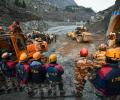
The study by an international team led by scientists at the UK's Newcastle University is the first global assessment of areas at greatest risk of Glacial Lake Outburst Floods (GLOF). Published in the journal Nature Communications on Tuesday, it estimates that 15 million people around the world are at risk from flooding caused by glacial lakes.

A team of scientists has identified a 'potentially dangerous' proglacial lake at 16,500 feet in Arunachal Pradesh's Mago Chu basin, a critical headwaters region of the Brahmaputra, warning of a possible Glacial Lake Outburst Flood (GLOF) due to rapid glacier transformation.

'There needs to be a monitoring of glaciers in high altitude areas and one needs to check regularly how geological changes are taking place.' 'We can mitigate that by regular monitoring but unfortunately, hardly any monitoring is happening.' 'And without monitoring those higher altitudes of Himalayas, people are suffering.'

Scientists are examining how a possible glacial collapse and ice-rock avalanche may have triggered the devastating flash floods along Nepal's Bhote Koshi River, with preliminary assessments indicating that debris may have temporarily blocked the Lhende River and created a landslide dam that subsequently gave way.

A senior Geological Survey of India official warns that the Himalayas are vulnerable to cascading disasters, where one high-altitude event can trigger a chain of destructive events downstream, as evidenced by Nepal's recent floods. He stresses the need for integrated monitoring using satellite data and ground investigations to identify high-risk areas and improve preparedness in the Indian Himalayas.

China on Friday said the collapse of a high-altitude glacier in Nepal may have triggered the massive flash flood disaster that engulfed the Tibet-Nepal border, killing hundreds and causing widespread damage.

A recent study by scientists indicates that the Hindu Kush-Himalaya region is experiencing increased frequency and intensity of extreme weather events due to climate change, including rapid glacial melting and changing rainfall patterns. However, the research also cautions against solely blaming climate change, highlighting that human factors like population growth, commercial activities, and non-enforcement of regulations contribute significantly to the vulnerability and impact of these disasters. The study points out that many devastating floods originate from small glaciers and rain-fed streams, exacerbated by encroachment on unstable slopes and floodplains.

Villages along the Uttar Pradesh-Bihar border are on high alert following devastating flash floods in Nepal, with authorities monitoring the Gandak River for potential downstream surges and the NDRF deploying 20 teams for preparedness.

'This is no longer a single-hazard problem; it is a cascading, multi-hazard problem. A landslide never occurs in isolation. This entire chain is the cascading effect of what looks, at first, like a single disaster.'


Nepal's former Forest and Environment Minister Madhav Prasad Chaulagain has expressed concern over the lack of timely information exchange with China ahead of the devastating floods, stating that the disaster's scale could lead to an 'unbelievable' rise in the death toll.

The NRSC satellite imagery revealed that the lake covered approximately 162.7 hectares. Its area increased to 167.4 hectares on September 28 but drastically reduced to 60.3 hectares.
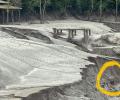
A GLOF occurred in parts of Lhonak Lake, leading to a rapid rise in water levels with very high velocities downstream along the Teesta River Basin in the early hours of October 4. This resulted in severe damage in Mangan, Gangtok, Pakyong and Namchi districts.

A study by an international team of researchers had warned two year ago that the South Lhonak lake in Sikkim may burst in the future and significantly impact the downstream region.

A massive flash flood originating in Tibet has devastated central Nepal, killing 17 people and leaving nearly 500 missing, including 105 Indians. The deluge, caused by a rock slide near the Nepal-Tibet border, swept through districts, washing away bridges and severely damaging at least a dozen hydropower projects.

'The Weather Channel argues that India faces the gravest challenge: Climate change-induced health vulnerability.' 'This is an issue often neglected, alerts Claude Arpi: "Prolonged summers, unpredictable rains, floods, droughts, and rising sea levels are the harsh realities of climate change in the country. These factors increase the frequency and severity of illnesses, pushing people into poverty, and forcing migration".'
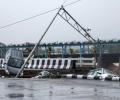
'Due to orographic rainfall, localised areas are experiencing intense downpours.' 'In a very heavy downpour, the burst of water has to find its way and therefore whatever comes in its path gets washed away.'

It has noted that melting glaciers due to any impact of climate change will not only severely affect the flow in Himalayan river system but will also give rise to natural disasters.

'We need an early warning system in India.'

Sikkim Chief Minister Prem Singh Tamang, better known as P S Golay, on Friday said that the Himalayan state has incurred damages worth thousands of crores of rupees in the flash flood.

Glaciers in the Karakoram region are in a stable condition, but those feeding the Ganga and the Brahmaputra river basins are melting at a faster rate, the earth sciences ministry has said.

More than 4.5 lakh pilgrims paid their obeisance at the natural ice Shiva Lingam formation inside the cave shrine last year.

A dozen teams of the NDRF will be deployed to ensure the safety of the people who embark on the yatra from July 1, they added.
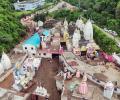
'What we are witnessing is not a freak incidence or a freak occurrence, but a new climate reality where warming oceans, monsoon variability and local geography are combining to produce extreme events.'
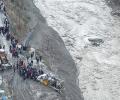
The study suggests that climate change is contributing to such events happening more frequently, and highlights risks of increasing development projects in fragile environments.

On day three after a flash flood wreaked havoc in Sikkim's Teesta basin, the number of bodies recovered from the river and mud embankments downstream rose to 22, including seven army men.

Uttarakhand Chief Minister Trivendra Singh Rawat said saving lives and extending all help to the families of the deceased is the state government's priority.

In recent years, the twin demands of both religion and defence have been added to the development argument to sweep aside environmental and terrain considerations while undertaking infrastructure development in the Himalayan zone, points out former foreign secretary Shyam Saran.
India tried to block the project at the fund's board meeting in South Korea, but later agreed to approve it with new condition, reports Nitin Sethi.
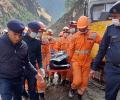
'Events like the one we saw on Sunday are complex geological processes which can be impacted by weather and climatic conditions.' 'It is difficult to attribute something like this to just one factor or to a particular time period, especially when we have still not understood the exact cause.'

'Above 2,000 metres the gradient of the Himalayas is very steep and if you build any infrastructure (roads, dams, hydro power projects) in these regions, it will not be able to sustain these events (the onslaught of debris that comes down with great speeds).'
